
Drive for long enough in the right direction from Manhattan, and New York starts changing surprisingly quickly. Skyscrapers give way to the Hudson River, wooded parkways, lakes, mountain roads, and eventually the Atlantic coast.
You do not even have to travel far to find some of the best scenic drives near NYC. One starts on Manhattan’s west side. Others take you across the Hudson, into Westchester, or farther north towards Bear Mountain and the Hudson Valley.
So, if you have a free morning, afternoon, or entire day, these eight NYC scenic drives are worth adding to your route.
Henry Hudson Parkway
You can actually begin a scenic drive without leaving Manhattan. The Henry Hudson Parkway starts around West 72nd Street and runs north for just over 11 miles towards the Bronx and the Yonkers border.
The road stays close to the Hudson for much of the journey. Around the lower sections, you still feel very much in Manhattan, with apartment buildings and the city close by. Head farther north, and more greenery starts appearing around the roadway, particularly as you pass Riverside Park, Fort Washington Park, and Upper Manhattan.
The section between West 72nd and West 129th Street is a designated New York City Scenic Landmark. The full parkway passes through or beside numerous parks and the Hudson River Greenway, so the drive feels much greener than you might expect from a road beginning on Manhattan Island.
This is a good route when you only have a couple of hours and do not want your scenic drive to turn into a full road trip. You can leave the parkway around Washington Heights and stop near Fort Tryon Park, or simply continue north.
It is also a convenient first drive if you are visiting and using a car rental in NYC. You get the city at the beginning, then gradually see another side of New York as you head north.

Bronx River Parkway
The Bronx River Parkway is a different experience again. Once you cross into Westchester, the road becomes a proper landscaped parkway, with the Bronx River, mature trees, and green spaces appearing alongside it.
The scenic section runs for 13.2 miles from the Bronx and Westchester boundary to Kensico Dam Plaza. It is officially designated as a New York State Scenic Byway, and its history goes back to the early twentieth century. In fact, construction began in 1907, making it one of America’s earliest limited-access automobile roads.
You do not need to care about road history to enjoy it, though. This is simply a pleasant drive, particularly when the trees are changing colour in autumn.
Kensico Dam Plaza gives you a proper endpoint rather than having to turn around at a random junction. Stop there, stretch your legs, and then decide whether to head back into the city or continue farther into Westchester.
One thing to check before you leave is Bicycle Sundays. On selected Sundays, part of the parkway closes to vehicles so cyclists, runners, and walkers can use it without traffic. Rather than relying on fixed dates, check the current schedule before setting out.

Palisades Interstate Parkway
Cross the George Washington Bridge into New Jersey, and the scenery changes almost immediately.
The Palisades Interstate Parkway runs for around 42 miles from the George Washington Bridge area towards the Bear Mountain Bridge. Much of the road is wooded, and it runs above the Hudson beside the cliffs that give the Palisades their name.
Do not just drive straight through.
Rockefeller Lookout is around a mile north of Exit 1 and gives you a view across the Hudson towards Spuyten Duyvil. A little farther north, Alpine Lookout sits around 430 feet above sea level. State Line Lookout is higher again and has several viewpoints over the river and surrounding landscape.
This is one of the easiest routes on the list to turn into a half-day trip. Stop at one or two overlooks, continue north, and then either turn back or carry on towards Bear Mountain.
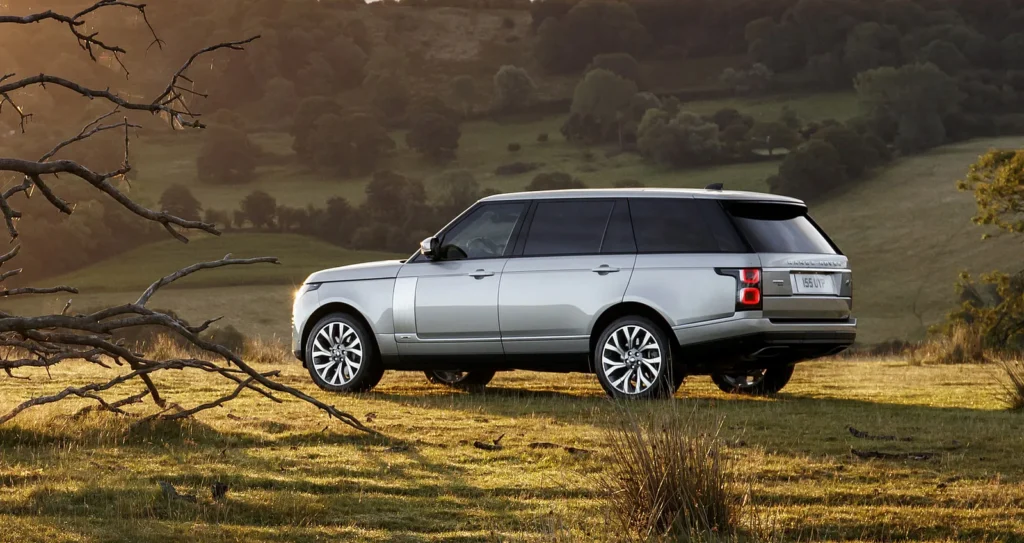
For a longer drive like this, vehicle choice starts to matter more than it does for a short run through Manhattan. A five-door SUV such as the Range Rover Autobiography gives you a different setup from a two-seat or two-door sports car, especially when you are carrying passengers or luggage. The wider Range Rover collection gives you other options for trips out of the city.
There is one important rule here. The Palisades Interstate Parkway is limited to passenger cars and motorcycles. Commercial vehicles, RVs, trailers, and vehicles with commercial or combination plates are prohibited, so check the classification of whatever you are driving before using the route.
Henry Hudson Drive
Do not confuse this one with Henry Hudson Parkway in Manhattan. They are completely different roads.
Henry Hudson Drive runs for around eight miles beneath the Palisades on the New Jersey side of the river. While the Palisades Interstate Parkway runs higher above the Hudson, this road drops you much closer to the water and the bottom of the cliffs.
That makes the scenery feel very different.
The drive begins at the Edgewater entrance and continues north towards Alpine. Along the way, you can stop around Ross Dock, the Englewood picnic area, and other riverfront sections. At points, the Palisades rise steeply beside you while the Hudson sits on the other side of the road.
The road is narrow and slower than the main parkway, which is part of the appeal. This is not the route for getting somewhere quickly. Give yourself time.
There are seasonal restrictions too. Henry Hudson Drive is generally open to motor vehicles during the warmer months, from May to November. In winter, the northern section closes to vehicles. Parts of the road also close on certain holiday weekends, and Dyckman Hill Road currently has access restrictions.
Check the Palisades park notices before making the drive the centre of your day. Conditions here can change.

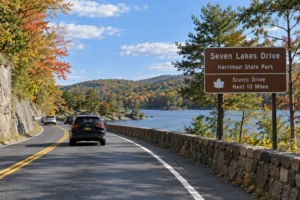
Seven Lakes Drive Through Harriman State Park
Once you reach Harriman State Park, New York feels a long way from Manhattan.
Seven Lakes Drive cuts through a landscape of forests, hills, and lakes. The road connects different parts of Harriman and Bear Mountain State Parks, with places such as Lake Tiorati and Silvermine giving you easy reasons to stop rather than staying behind the wheel all day.
This is one of the best drives on the list in autumn. Once the leaves begin changing, long sections of the route are surrounded by colour. Summer is good too, especially if you plan to combine the drive with a picnic, walk, or longer stop beside one of the lakes.
There are plenty of hiking trails in Harriman, but you do not have to turn the day into a serious hike. Even stopping for half an hour beside the water breaks up the drive nicely.
Expect bends. Plenty of them.
If you are making a full day of Harriman and Bear Mountain, the Ford Mustang GT is another model available in the NYC fleet. You can also browse the wider Ford rental range before choosing a car for the route.
The important thing is to allow enough time. Seven Lakes Drive is better when you can stop rather than treating the road as a shortcut to Bear Mountain.
Perkins Memorial Drive to Bear Mountain Summit
Already driving through Harriman? Add this one.
Perkins Memorial Drive climbs Bear Mountain towards Perkins Memorial Tower. It is much shorter than Seven Lakes Drive, but the payoff comes as you gain elevation and the surrounding landscape opens up.
At the summit, the tower gives you broad views over Bear Mountain State Park, Harriman State Park, and the Hudson Highlands.
Seven Lakes Drive and Perkins Memorial Drive make a good combination for the same day because they give you two completely different types of scenery. Seven Lakes is about forests, bends, and water. Perkins is about climbing and seeing the landscape from above.
The road is seasonal. In 2026, Perkins Memorial Drive and Tower are scheduled to operate from April 1 through November 30, weather permitting.
Outside that period, do not assume the road will be accessible just because Bear Mountain State Park itself is open.
If you would rather spend a separate sightseeing day looking out of the window than concentrating on the road, you can also arrange a chauffeur in New York. Keep in mind that several parkways around the region restrict commercial vehicles, so a chauffeur itinerary should be planned around roads the vehicle is permitted to use.

Wantagh State Parkway and Ocean Parkway to Captree
Most of the routes so far have taken us north. This one goes in the opposite direction.
Head east from New York City onto Long Island, then take Wantagh State Parkway south towards Jones Beach. Once you reach the barrier island, continue east along Ocean Parkway towards Captree.
It feels very different from driving through the Hudson Valley.
The southern section of Wantagh State Parkway and Ocean Parkway form part of New York’s selected Historic Long Island Scenic Parkways. The routes were chosen for their historic and scenic character, along with several other Long Island parkways.
Jones Beach is the obvious stop. You can pull off, walk towards the Atlantic, and spend some time by the water before continuing east.
After Jones Beach, Ocean Parkway runs through coastal landscapes shaped by the Atlantic Ocean and Great South Bay. Keep going, and you eventually reach the Captree area, giving the drive a clear destination.
Summer is the obvious time for this route, especially if you want a beach stop. A clear spring or early autumn day can be just as enjoyable and often means you are less focused on beach crowds.
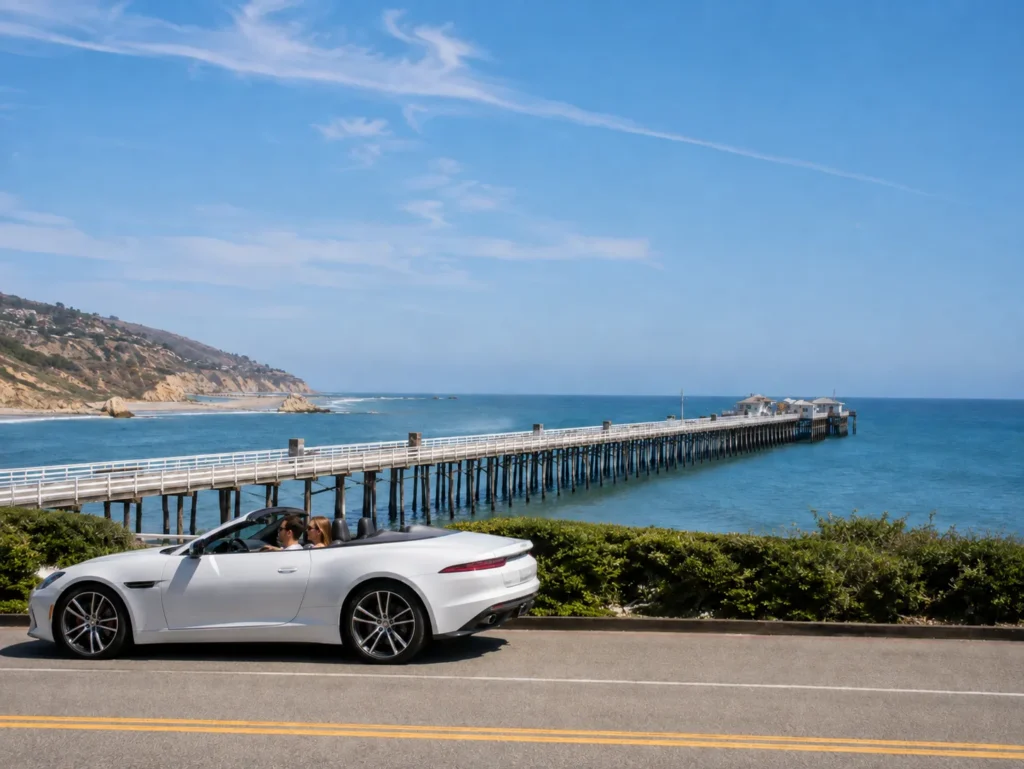
This is also the route where an open-top car makes the most obvious practical difference. The Ferrari F8 Spider has a retractable hardtop, so you can switch to open-top driving when the weather suits. The wider Ferrari collection gives you other options if you would rather stay with a coupe.
If your New York plans are not all about driving, our guide to 12 luxury things to do in NYC has more ideas for filling another day.

Taconic State Parkway
Have more time? Head north.
The Taconic State Parkway begins in Westchester and continues for more than 100 miles through Putnam, Dutchess, and Columbia counties towards Chatham. You certainly do not need to drive all 104 miles to enjoy it.
The road was designed as a scenic parkway, and that shows. It follows a winding, hilly route rather than feeling like a modern interstate. As you travel farther north, the suburbs fall away and the countryside becomes increasingly prominent.
Views open towards the Hudson Highlands, Catskills, and Taconic landscape along different parts of the road. The bridges and surrounding parkway design were also deliberately planned to sit within the scenery rather than dominate it.
Autumn is hard to beat here. You get long stretches of changing leaves without needing to plan a complicated mountain route.
For a half-day trip, choose a sensible turnaround point rather than chasing the end of the parkway. For a full day, you can continue deeper into the Hudson Valley and build stops around the towns and countryside farther north.
And if you have spent most of your visit around Midtown and the famous sights, our guide to hidden gems in Manhattan is a good reminder that you do not always need to leave the city to find something different.

Check Road Conditions Before You Leave
Traffic can change these trips considerably, especially when you are leaving Manhattan on a Friday afternoon or returning on a Sunday evening.
Check current traffic before setting out. 511NY provides live traffic speeds, incidents, and road-condition information for New York State.
Park roads deserve an extra check. Henry Hudson Drive has seasonal restrictions. Perkins Memorial Drive can close because of weather. Bicycle Sundays affect the Bronx River Parkway on selected dates.
Do not plan the whole day around one road without checking that road first.
If you are travelling with passengers who would rather leave the driving to someone else on a different route, STARR also has chauffeur options such as the Rolls Royce Phantom Series VIII and Rolls Royce Cullinan. The route still needs to allow the vehicle type being used.