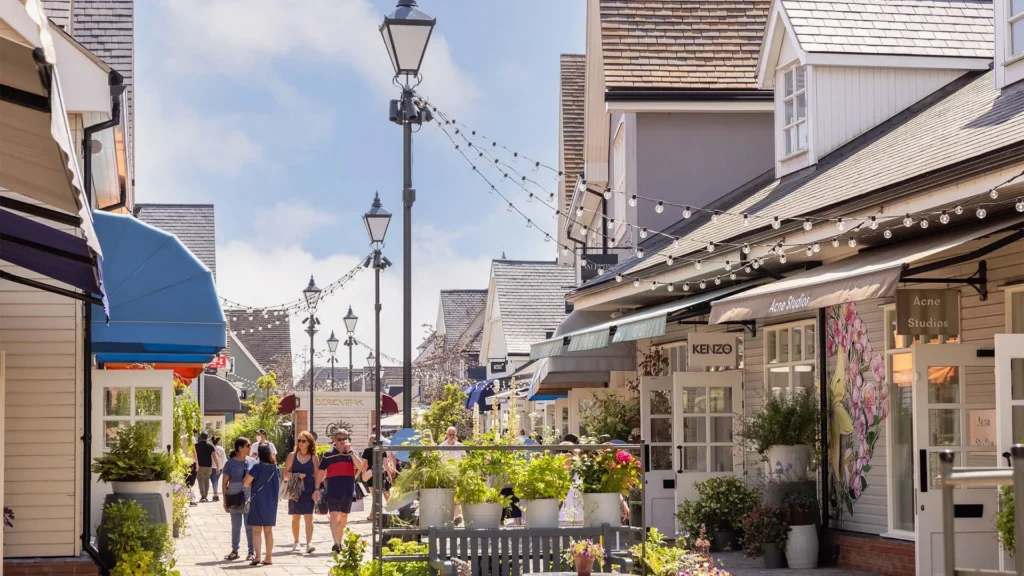

Manhattan does not exactly struggle for famous attractions. Times Square, Central Park, the Empire State Building and Fifth Avenue could fill several days before you even start looking elsewhere.
But some of the most interesting places on the island are much easier to miss. There is a museum hidden in an alley, a garden sitting above a Financial District office block and an artwork beneath the feet of thousands of people in Times Square. Head farther uptown and you will find historic wooden houses, overlooked museums and one of New York’s most impressive public gardens.
Some of these hidden gems in Manhattan take less than half an hour to explore. Others are worth building an afternoon around. Either way, they give you a good excuse to leave the standard sightseeing route for a while.
The New York Earth Room
A room full of dirt in the middle of SoHo? Yes, really.
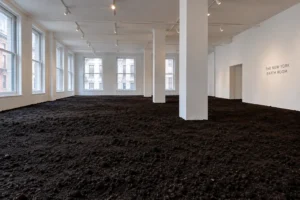
Walk to 141 Wooster Street, head upstairs and you will find Walter De Maria’s The New York Earth Room. The installation covers 3,600 square feet with 250 cubic yards of earth, spread to a depth of 22 inches. It has been here since 1977.
There is no elaborate exhibition to work through. You stand behind a barrier and look across a huge expanse of dark soil inside an otherwise white Manhattan loft. The smell of earth is part of the experience too, which only makes the contrast with the streets outside more noticeable.
The location is what makes it such a good stop. You could spend the morning browsing SoHo’s stores and galleries without having any idea this exists one floor above the pavement.
Admission is free. The Earth Room currently opens Wednesday to Sunday from noon to 3pm, closes for half an hour, then reopens from 3:30pm to 6pm. (Dia Art Foundation)
The Earth Room is right in the middle of SoHo, so there is plenty nearby once you step back outside. Dia’s The Broken Kilometer is a short walk away on West Broadway, while Nolita and Greenwich Village are both easy to continue on to from here.
Mmuseumm
Mmuseumm is easy to miss. That’s rather the point.
You will find it at 4 Cortlandt Alley in Lower Manhattan, tucked into a space that once served as a freight elevator. The museum focuses on everyday objects that say something about the modern world, rather than paintings, sculptures or the usual museum pieces.
The exhibitions change, but the idea remains wonderfully simple. Ordinary things become much more interesting when someone gives you a reason to look at them properly.
It is tiny. Do not plan half a day around it.
Instead, work it into a walk through Tribeca, Chinatown or Lower Manhattan. Cortlandt Alley itself is worth a slow look too. The narrow passage, fire escapes and older façades look very different from the glass towers just a few blocks away.
Mmuseumm’s 2026 public hours are currently Saturday and Sunday from 11am to 6pm. (Mmuseumm)

New York Marble Cemetery
There are two historic cemeteries with very similar names in this part of Manhattan. The one you are looking for here is the New York Marble Cemetery at 41½ Second Avenue.
Even the address gives away how hidden it is.
The entrance sits between buildings on Second Avenue in the East Village. Walk through and you reach a walled green space dating back to the 1830s, with marble plaques built into the surrounding walls rather than rows of conventional headstones.
It is one of those places that makes you look at the neighbourhood differently. Step back onto Second Avenue afterwards and the restaurants, apartment buildings and traffic are right there again.
There is one catch. You cannot simply turn up whenever you please.
The cemetery opens to the public on selected dates, generally at least once a month between April and October. Its official calendar lists specific open-gate days, so check before making the journey. (New York Marble Cemetery)
If the gates are open while you are in New York, go in.

The Elevated Acre
You could walk along Water Street several times and never realise there is an acre of landscaped public space above you.
The Elevated Acre sits at 55 Water Street in the Financial District. Look for the escalators from street level, head up and the office blocks suddenly give way to lawn, planting, seating and views towards the East River and New York Harbor.
This is not a huge park. That’s part of its appeal.
Grab lunch nearby, come up for half an hour and sit somewhere away from the streets below. It also works nicely with a Lower Manhattan afternoon that includes Wall Street, Stone Street, the Battery or the South Street Seaport.
New York City planning documents identify the Elevated Acre as a publicly accessible space above the 55 Water Street parking garage, with access from Water Street and South Street.
Manhattan’s hidden places are spread out, though. Once your itinerary starts jumping between the Financial District, Midtown and Upper Manhattan, the journey between stops becomes part of the day. Rather than finding a new garage every few hours, you can arrange a chauffeur in New York. A chauffeur-driven Mercedes S-Class is one option for a multi-stop itinerary where you would rather get out at the door and keep moving.

Ford Foundation Atrium Garden
There is a garden inside the Ford Foundation building on East 43rd Street, and it is much bigger than you might expect.
Walk into the Ford Foundation Center for Social Justice and the interior opens into a tall atrium filled with trees, shrubs and other planting arranged around a reflecting pool. The garden stretches through several levels of the building rather than sitting in one neat bed at ground level.
It is a good Midtown stop because it gives you something very different from nearby Grand Central Terminal, the Chrysler Building and the busier blocks around Fifth Avenue.
You could also pair the garden with the foundation’s gallery. The exhibitions focus on contemporary art and social issues, so allow a little more time if something on the current programme catches your attention.
There is an important bit of planning here. Garden and gallery visitors currently need to pre-register by 5pm on the day before their visit, and visitors go through security at the entrance on East 43rd Street. (Ford Foundation)
Do that first. Turning up without checking is an easy way to waste the stop.

Max Neuhaus’s Times Square
Putting Times Square in a hidden-gems article sounds wrong until you know what you are looking for.
Near the north end of the pedestrian island on Broadway between 45th and 46th Streets, there is an artwork beneath your feet. No giant sign points to it. There is no ticket booth and no gallery entrance.
Just listen.
Max Neuhaus’s Times Square produces a deep, layered sound from beneath the pedestrian plaza. The installation first appeared here in 1977, disappeared in the 1990s and returned permanently in 2002.
The fun part is watching everyone else. Thousands of people cross one of the world’s busiest tourist areas while an artwork is playing underneath them, and most never stop.
Dia says the installation operates 24 hours a day, seven days a week. (Dia Art Foundation)
You only need a few minutes, so there is no reason to make a special trip across Manhattan for it. Add it when you are already around Times Square, Broadway or Rockefeller Center.
If your evening continues with dinner and a show in another part of Manhattan, this is also where having a driver starts to make practical sense. A chauffeur-driven Rolls Royce Ghost Series II means you are not hunting for parking between the theatre district and the next reservation.

Hallett Nature Sanctuary
Central Park is not hidden. Hallett Nature Sanctuary still manages to stay off many visitors’ itineraries.
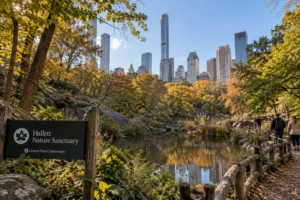
The four-acre woodland sits at the southeastern corner of the park between 60th and 62nd Streets. That puts it remarkably close to some of Manhattan’s busiest streets, but the paths lead through a much smaller and quieter landscape than the park’s famous lawns.
The sanctuary was fenced off as a bird habitat in the 1930s and remained closed to the public for decades. Today you can follow the rustic paths through woodland and look out over the Pond.
It is particularly easy to add to a Fifth Avenue day. The Plaza, Central Park South and the shops along Fifth Avenue are all nearby, so you do not have to disappear deep into the park to reach it.
The Central Park Conservancy currently lists the sanctuary as open daily from 10am until 30 minutes before sunset. (Central Park Conservancy)
Give yourself around half an hour if you simply want to walk through. Stay longer if the park is already part of the day’s plan.
The Hispanic Society Museum & Library
Most first-time visitors looking for art in Manhattan head towards the Met, MoMA or the galleries downtown. Keep going north instead.
The Hispanic Society Museum & Library sits at Audubon Terrace in Washington Heights, between West 155th and 156th Streets. Its collections cover the art and culture of Spain, Portugal, Latin America and the Philippines, with works spanning centuries.
The setting deserves attention before you even enter. Audubon Terrace is a group of imposing Beaux-Arts buildings arranged around an elevated courtyard, a long way from the glass-and-steel version of Manhattan many visitors spend most of their trip seeing.
Inside, one of the major attractions is Joaquín Sorolla’s Vision of Spain, a monumental cycle of paintings depicting regions and traditions across Spain.
Admission is free, although visitors currently need to reserve a free ticket before entering the galleries. The museum opens Thursday to Sunday from noon to 5pm. (Hispanic Society Museum & Library)
This is also one of the more straightforward stops on our list if you are already travelling by car. The museum notes that free parking is available on West 155th Street beside its buildings. If Manhattan is only one part of a wider New York itinerary, you can rent a luxury car in NYC and continue north afterwards rather than treating the car as a way to hop between downtown sights.
For more passenger and luggage space on that sort of trip, the Range Rover collection includes models such as the Range Rover Autobiography.

Sylvan Terrace
Walk a few blocks north from the Hispanic Society and Manhattan changes again.
Sylvan Terrace is a short residential street in Washington Heights with two rows of small wooden houses facing each other across the narrow road. There are ten on each side, all built in 1882.
That alone makes them unusual in Manhattan.
The street follows part of an old carriage route that once led towards the Morris-Jumel Mansion, which you can see at the eastern end. The wooden façades, shutters and tightly packed stoops look very different from the apartment blocks surrounding the neighbourhood.
New York City’s Landmarks Preservation Commission identifies the houses as part of the Jumel Terrace Historic District and records their construction in 1882.
Remember that Sylvan Terrace is residential. Walk through, take photographs from the public street and leave the doorways and stoops to the people who live there.
It pairs well with the Hispanic Society because the two stops are close enough to make the trip uptown worthwhile. Travellers continuing farther north after Manhattan may also prefer a four-door car for the day. The Bentley collection in NYC includes the Bentley Flying Spur if New York City is the starting point rather than the end of your drive.
Heather Garden at Fort Tryon Park
Keep heading uptown for our final stop.
Fort Tryon Park is best known to visitors because it is home to The Met Cloisters, but the Heather Garden near the park’s southern entrance deserves time of its own.
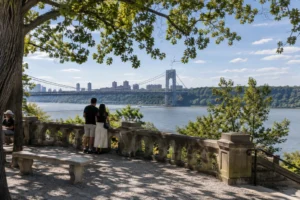
The garden covers roughly three acres and contains more than 650 varieties of plants, including trees, shrubs, bulbs, perennials, heaths and heathers. A long perennial border follows the edge of the garden, while sections of the park open towards views of the Hudson River and the Palisades.
What makes it worth the journey is the combination of garden and setting. This is still Manhattan, but there is enough space here to slow the day down before heading to the Cloisters or walking farther through Fort Tryon Park.
The planting changes throughout the year. The Fort Tryon Park Conservancy publishes monthly bloom information, so there is usually something different to look for rather than one short peak season. The garden also has unrestricted public access, while Fort Tryon Park itself currently opens from 6am to 1am. (Fort Tryon Park Trust)
Fort Tryon is accessible by car as well as subway and bus. If Manhattan is one part of a wider New York stay, the Porsche 911 Carrera is another self-drive option for continuing beyond the city. The Mercedes S-Class also sits within STARR’s wider Mercedes rental collection.
If you still have time to explore the city, our guide to luxury things to do in NYC covers more experiences to add to your New York itinerary.

Finding the Manhattan Most Visitors Miss
You do not need to abandon Manhattan’s famous sights to find something different. Some of its best hidden places are only a few blocks from the attractions everyone already knows.
See the Earth Room while you are shopping in SoHo. Listen for an artwork beneath Times Square. Take the escalator above Water Street instead of walking past it. And when you have covered enough of downtown and Midtown, head north. Washington Heights and Fort Tryon Park reward the extra journey with places that rarely appear on a first-time NYC checklist.
The trick is not trying to see all ten in one day. Pick a few in the same part of Manhattan, leave space to wander between them and save the rest for another visit.